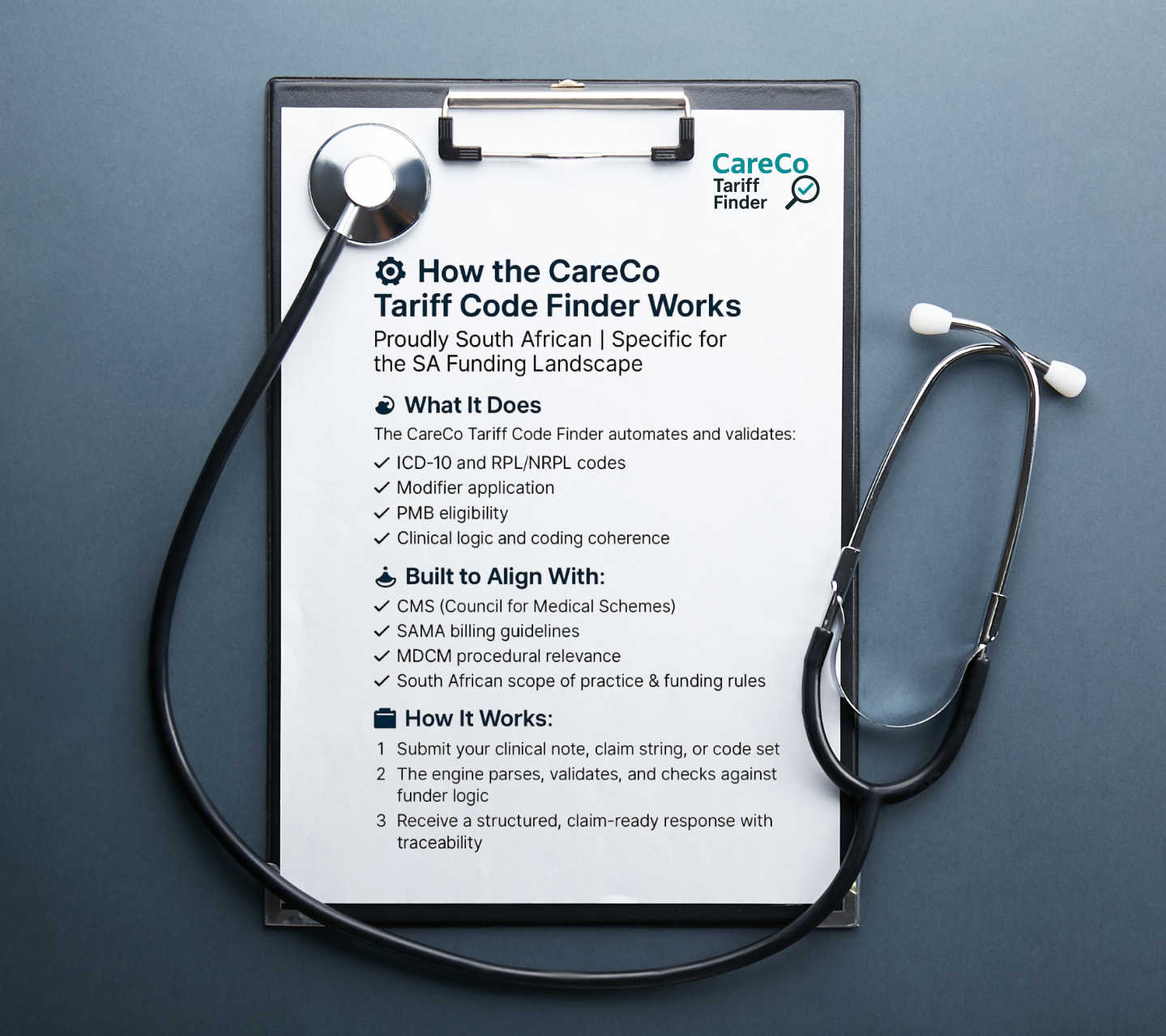
-How It Works-
CareCo Tariff Finder

AI in Healthcare Funding?
At CareCo Solutions, We believe automation in clinical coding should be:
Traceble
Auditable
Locally Compliant
That’s why we built our Tariff Code Finder with Deterministic AI-not generative guesswork.
It doesn’t write content or “LEARN ON THE JOB”
Instead, it applies structured logic aligned with South African coding standard, including CMS, SAMA (MDCM), and PMB frameworks.
Outputs are static. Rules are fixed.
You get fast, funder-aligned validation with zero surprises.
What Makes It Different?

- Validates coding within frameworks aligned with CMS and SAMA.
- Incorporates MDCM guidance for procedure relevance and modifier rules.
- Operates strictly within the scope of practice and scheme coveragerules.
- Provides only validated outputs, without "hallucinations" or free-text guesswork.
- It is a clinical automation engine that uses AI methods for structure extraction, not for interpretation.

The Central coding "brain"
MedCascade: Foundation of a Health Tech Ecosystem
MedCascade is more than a coding tool—it’s a platform that can power and connect an entire health tech ecosystem, providing accurate, validated, and shareable clinical and billing data across the healthcare value chain.
Input Stage: Accepting All Types of Medical Data
MedCascade starts by accepting a wide range of inputs codes:
ICD-10, CCSA, NRPL, written descriptions (conditions, symptoms, treatments), or even free text clinical notes via the CareCo Tariff Finder engine.
This means any doctor, nurse, or admin can feed in whatever information they have, structured or unstructured.
AI Processing & Validation
At its core, MedCascade uses advanced AI to make sense of the data:
NLP (Natural Language Processing) breaks down free-text and recognizes medical terms.
Entity Recognition picks out the relevant diagnoses, procedures, and context.
Once the data is extracted, MedCascade:
- Flags errors, incomplete, or outdated codes.
- Checks coding relevance against official sources (ICD-10, CCSA, NRPL).
- Verifies billing compliance with medical aid and insurer rules.
- Automatically maps codes between systems (for example, turning an ICD-10 code into its CCSA/NRPL equivalent).
- Selects the right specialty context (e.g., cardiologist vs. nephrologist) to improve accuracy.
- Validates comorbidities and confirms all clinically relevant codes are present.
Why it matters:
This is the engine that ensures both clinical and billing accuracy, reducing manual admin and
costly mistakes.
AI Learning & Continuous Improvement
MedCascade doesn’t just automate coding, it gets smarter over time.
If someone corrects an error, the AI adapts. It also keeps up-to-date automatically as coding guidelines change (e.g.,
new ICD-10 or insurer requirements).
Why it matters:
The system continually improves, ensuring future-proof compliance and reducing the burden of manual updates.
Output & Transcription
Once coding is validated:
MedCascade generates a structured report: including primary diagnosis,
comorbidities, and billing justifications.
Data is output in formats ready for integration: JSON, HL7, or FHIR—industry standards for EHRs, billing systems, and medical transcription.
Why it matters:
This step turns complex AI decisions into simple, usable data for all parts of the healthcare ecosystem.
Seamless Sharing & Market Advantage
MedCascade is built to distribute results automatically to:
- Billing & admin teams (for claim submissions)
- Medical aids & insurers (for faster claim approvals)
- Hospitals & front desks (for quick patient record updates)
Why it matters:
This creates a connected, interoperable environment. It reduces manual work, speeds up claims, and offers a clear competitive advantage, especially in the South African context where coding accuracy and compliance are critical.
Why it Matters
- Accuracy: MedCascade ensures both clinical and billing accuracy, which reduces costly mistakes and manual administrative work.
- Compliance: It provides future-proof compliance by automatically staying up-to-date with changing coding guidelines and insurer requirements. This is a significant advantage, especially in the South African context where coding accuracy is critical.
- Efficiency: The automation of coding speeds up claims and reduces the burden of manual updates.
- Interoperability: The platform's structured outputs and sharing functions create a connected, interoperable environment.